EN 397:2025 – the new industrial helmet standard: what changes and how to prepare
Oct 25, 2026 · 10 min read
The first (1995) and second (2012) editions of EN 397, the industrial helmet standard, essentially knew one helmet: the one that protects against an object falling onto the crown. The 2025 edition distinguishes two types, treats impacts away from the crown as part of the helmet’s job, brings new tests and withdraws a few old requirements. Manufacturers and distributors have until 16 December 2027 to make the switch.
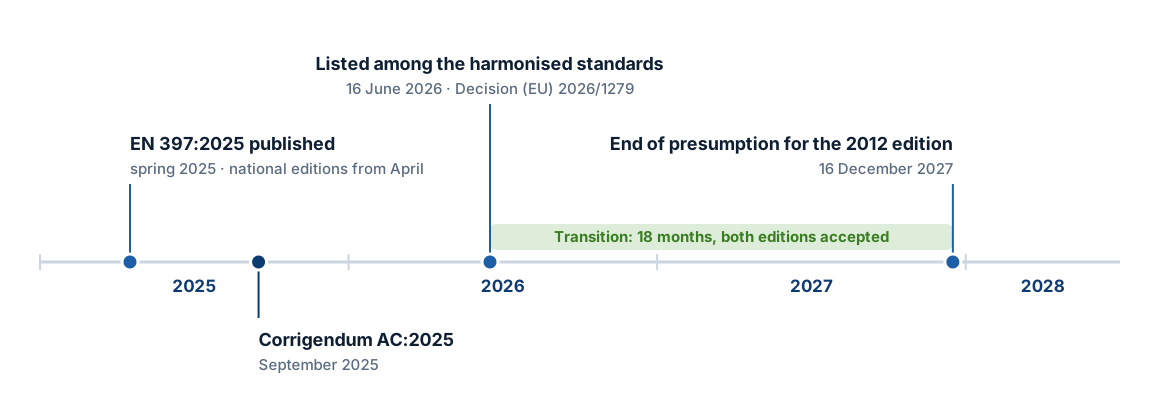
CEN published EN 397:2025 in spring 2025 – the national editions appeared from April 2025, followed by a corrigendum (AC:2025) in September 2025; the Hungarian national edition, MSZ EN 397:2025, is available in English with a Hungarian cover page from the Hungarian Standards Institution, and MSZ EN 397:2012+A1:2013 is withdrawn. On 16 June 2026 the European Commission listed it, by Implementing Decision (EU) 2026/1279, among the harmonised standards under Regulation (EU) 2016/425 on personal protective equipment (PPE): from that day, conformity with the new edition gives presumption of conformity. EN 397:2012+A1:2012 stays in the same list until 16 December 2027 – until then both editions are accepted, afterwards only the new one. This article summarises the changes on the basis of the 2022 draft of the standard (prEN 397:2022) and the public summaries of the 2025 edition; the exact wording of the requirements is the standard itself.
Why a new standard?
According to the standard’s introduction, the typical causes of head injuries at work are, besides falling objects, slips, trips and falls – from the same level or from height –, loss of control of machinery and electrical hazards. Of these, the 2012 edition addressed only the falling object. Whoever wanted protection against lateral impacts as well turned to EN 12492 for mountaineering helmets or EN 14052 for high-performance industrial helmets – but the former is a leisure standard and the latter is offered by few manufacturers. Type 2 of EN 397:2025 closes that gap: an industrial helmet with off-crown impact protection and a mandatory chinstrap.
For rotational (tangential) impacts the standard still has no test method; CEN/TC 158 promises one for a later edition. A helmet still reduces, rather than eliminates, the risk of head injury – a warning the instructions for use must continue to carry.
The biggest change: Type 1 and Type 2
| Type 1 | Type 2 | |
|---|---|---|
| Protects against | An object falling on the crown – the helmet of the 2012 edition | An object falling on the crown, also with higher energy, and impacts from the front, the sides and the rear |
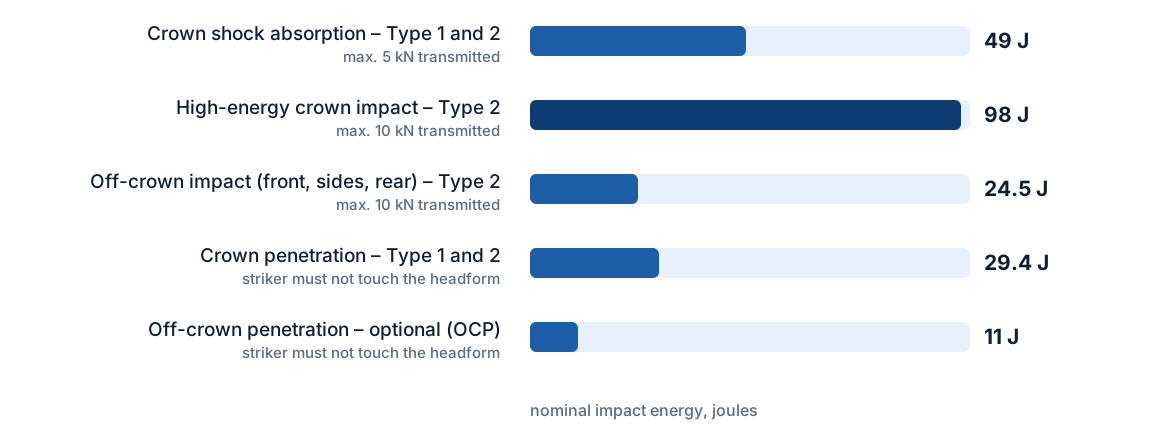
| Crown shock absorption | 49 J (5 kg striker from 1 m), transmitted force max. 5 kN | the same, plus 98 J (2 m) with max. 10 kN transmitted force |
| Off-crown impact | – | 24.5 J with a flat striker on a headform tilted 30°, at the front, the sides and the rear, max. 10 kN |
| Penetration | one impact within a 50 mm radius of the crown | two impacts at least 50 mm apart |
| Chinstrap | optional; if fitted, at least 10 mm wide and releasing at no less than 150 N | mandatory; at least 10 mm wide and releasing at no less than 500 N |
| Retention system effectiveness | – | roll-off test from the front and the rear: the helmet must not come off the headform |
| Sizing | – | adjustable continuously or in steps of at most 5 mm |
| Ergonomic assessment | – | wearer trial with test subjects: donning, adjustment, handling of accessories, staying in place during movement |
| Marking | EN 397:2025 T1 | EN 397:2025 T2 |
What affects every helmet
| Area | EN 397:2012+A1:2012 | EN 397:2025 – and who is affected most |
|---|---|---|
| Flame resistance → resistance to ignition | flame test: burning for no more than 5 s after removal of the flame | a steel rod heated to 650 °C held on the shell for 5 s: the shell must neither ignite nor continue to glow. Affected: every manufacturer – the shell material has to be retested |
| Drop speed | drop height (1 m) | measured impact velocity (4.43 m/s ± 0.07), measured at every impact in a guided fall. Affected: laboratories; more reproducible results for the manufacturer |
| Ventilation holes | a requirement on the total area of the holes | pin test: a 6 mm pin vertically and a 12 mm pin in any direction must not touch the headform. Affected: manufacturers of vented helmets |
| Accessories | – | the helmet is tested with and without non-integral protective functions (visor, hearing protectors) and accessories (lamp, camera); the manufacturer lists the accessories that do not affect conformity. Affected: every manufacturer offering accessories – no more “assumed compatibility” |
| Conditioning | –10 °C, +50 °C, water immersion, artificial ageing | the same; very low temperature can be claimed in 10 °C steps down to –40 °C, +150 °C can be claimed separately. Affected: manufacturers of helmets used in cold or heat |
| Marking on the shell | standard number, manufacturer, year and quarter of manufacture, type, size, shell material | EN 397:2025 + T1 or T2, manufacturer, date of manufacture (month and year according to the draft), model, size range in cm; the shell material abbreviation moves to the instructions. Affected: every manufacturer – new label, new mould insert |
| Instructions for use | basic information | extended: guidance on lifespan (how to assess it, when to replace), the list of accessories and spare parts, for Type 1 a statement on the role of the chinstrap, electrostatic and visibility warnings. Affected: every manufacturer and importer, in every language of sale |
| Measurement uncertainty | – | Annex B: to be stated in the test report and taken into account in the assessment. Affected: laboratories, notified bodies |
Special applications: what came, what went
| Marking | 2012+A1 → 2025 | What it means |
|---|---|---|
| –20 °C / –30 °C | optional → stays, extended with –40 °C | impact and penetration tests after conditioning at the claimed temperature |
| +150 °C | optional → stays | impact and penetration tests after conditioning at 150 °C |
| 440 V AC | optional electrical insulation → withdrawn | an electrically insulating helmet only to EN 50365:2023; a vented helmet cannot be one |
| LD | optional lateral deformation → withdrawn | lateral protection is taken over by the off-crown impact test of Type 2 |
| MM | optional molten metal splash → stays | molten iron on the shell: no penetration, no burning after 5 s |
| OCP | – → new, optional | resistance to off-crown penetration (11 J) |
| Electrostatic properties | – → new, optional | for explosive atmospheres: dissipative, conductive or insulating materials tested to EN 60079-32-2; the instructions state the gas and dust explosion groups and zones |
| Enhanced visibility | – → new, optional | fluorescent shell within a prescribed colour range, for daylight and/or dark conditions, with at least 80 cm² of retroreflective surface |
What does this mean for manufacturers?
The key fact: after 16 December 2027 an EU Declaration of Conformity based on EN 397:2012+A1:2012 no longer gives presumption of conformity with the essential requirements of Regulation (EU) 2016/425. Existing EU type-examination certificates formally remain in force until their expiry, but from that day placing on the market requires a type-examination to the new edition. Certificates run for at most five years, so those expiring after 2028 will have to be renewed anyway – it pays to combine the switch with that renewal, and not to join the queue in autumn 2027.
- 1 Product portfolio and typeDecide per model whether to certify it as Type 1 or Type 2. Type 2 means a mandatory chinstrap, a roll-off test and an ergonomic assessment – a design decision, not a marking question.
- 2 Gap analysis for the new testsResistance to ignition instead of the flame test, the pin test on ventilation holes, testing with and without accessories, measured drop speed; for Type 2 the high-energy and off-crown impacts. Where the outcome is uncertain, pre-testing is the way to base the decision.
- 3 Special applicationsTake the 440 V AC and LD markings off the range, decide on insulation to EN 50365:2023, and weigh the new claimable properties: OCP, electrostatic properties, enhanced visibility.
- 4 Marking and instructions for useA new label (EN 397:2025 T1/T2, size range, date of manufacture), the shell material abbreviation into the instructions, lifespan guidance, the list of accessories, the chinstrap statement for Type 1, electrostatic and visibility warnings – in every language of sale.
- 5 EU type-examination and documentationA new type-examination to EN 397:2025 at the notified body, then a new EU Declaration of Conformity citing the 2025 edition, and an updated technical file.
- 6 A transition plan for distributorsWhich model gets its 2025 certificate when, how long it is produced with the 2012 marking, what happens to stock – that is what distributors and large buyers will ask.
What does this mean for distributors and employers?
- 1 StockHelmets placed on the market – that is, first made available in the EU – before 16 December 2027 may still be sold after the transition; their declaration refers to the edition valid when they were placed on the market. Whatever is first placed on the market after that date must conform to EN 397:2025.
- 2 Product dataCatalogues and web shops deserve a separate field for the type (T1/T2) and the special applications; an EN 12492 mountaineering helmet is not a Type 2 industrial helmet, and vice versa.
- 3 Ask the manufacturerWhich model gets the new certificate when, and what the plan is for models carrying the 440 V AC or LD marking.
- 4 Employers: no obligation to replaceHelmets in use to EN 397:2012+A1:2012 do not become non-compliant: they may be used on according to the manufacturer’s lifespan guidance and the rule of replacement after a severe impact. The risk assessment, however, deserves a review: where lateral impacts or the helmet coming off are the risk, Type 2 is the answer.
- 5 Reading the new labelEN 397:2025 T1 or T2, next to it the markings of the special applications (–20/–30/–40 °C, 150 °C, OCP, MM, visibility, electrical insulation – the latter to EN 50365). Look for the shell material abbreviation in the instructions from now on.
Sources
- Harmonised standards – personal protective equipment (European Commission)Implementing Decision (EU) 2026/1279 and the summary list: EN 397:2025 + AC:2025 from 16 June 2026, presumption of conformity of EN 397:2012+A1:2012 until 16 December 2027.
- Commission Implementing Decision (EU) 2026/1279 – EUR-Lex
- MSZ EN 397:2025 Ipari védősisakok – Hungarian Standards InstitutionThe Hungarian national edition (in English with a Hungarian cover page); MSZ EN 397:2012+A1:2013 is withdrawn.
- Regulation (EU) 2016/425 on personal protective equipment
Questions about PPE certification?
Our team is glad to help with PPE laboratory testing, EU type-examination (Module B) and Module C2/D production surveillance.
Contact us