
Notified Body · No. 2233
CE Certification for Personal Protective Equipment (PPE)
EU type-examination and production surveillance under Regulation (EU) 2016/425 — helping PPE manufacturers worldwide obtain the CE mark.
Category II and III PPE require an EU type-examination by a notified body; Category III also requires notified-body oversight of production (Module B + C2/D).
Without the CE mark, PPE cannot lawfully be placed on the EU/EEA market.
The CE mark is your product’s passport to the EU/EEA single market — a precondition for sale and a mark of trust that makes it commercially viable.
What you receive
- An EU type-examination certificate (Module B)
- Production-surveillance documentation (Module C2/D)
- Laboratory test reports (ISO/IEC 17025)
- Notified-body backing verifiable in NANDO
GÉPTESZT is an EU notified body (No. 2233) that helps personal protective equipment manufacturers worldwide obtain the CE mark under Regulation (EU) 2016/425. We focus on high-risk Category III PPE. EU type-examination rests on examining the technical documentation and testing representative samples; the required tests are run in our own ISO/IEC 17025 laboratory, drawing on cooperating laboratories where needed.
Is your PPE Category III?
PPE is classified by the risk it protects against. Category III covers the most serious hazards and always requires a notified body — for both the type-examination and production. It comprises exclusively the risks that may cause death or irreversible harm:
- ▪Substances and mixtures hazardous to health
- ▪Atmospheres with oxygen deficiency
- ▪Harmful biological agents
- ▪Ionising radiation
- ▪High-temperature environments (≥ 100 °C)
- ▪Low-temperature environments (≤ −50 °C)
- ▪Falling from a height
- ▪Electric shock and live working
- ▪Drowning
- ▪Cuts by hand-held chainsaws
- ▪High-pressure jets
- ▪Bullet wounds or knife stabs
- ▪Harmful noise
Source: Regulation (EU) 2016/425, Annex I, as reproduced in the European Commission’s PPE Regulation Guidelines. Category I covers minimal risks (self-certified by the manufacturer); Category II is everything not in Category I or III.
Conformity assessment modules under Regulation (EU) 2016/425
The route to CE marking depends on the PPE risk category. For Categories II and III a notified body — GÉPTESZT (NB 2233) — must be involved; for Category III, throughout production.
E.g. superficial mechanical injury, mild cleaning agents — gardening gloves, sunglasses.
The manufacturer ensures and declares conformity itself. (Annex IV)
No notified body required.
Everything not in Category I or III — e.g. general protective gloves, high-visibility clothing, head protection.
A notified body examines the documentation and tests a representative sample. (Annex V)
The manufacturer ensures series production conforms to the type (internal production control). (Annex VI)
E.g. fall protection, respiratory, chemical and high-voltage risks — GÉPTESZT’s core area.
Examination of the documentation and testing of a representative sample. (Annex V)
Production surveillance — one module
At random intervals, by a notified body. (Annex VII)
Assessment and surveillance of the manufacturer’s quality management system. (Annex VIII)
As notified body NB 2233, GÉPTESZT performs Module B (EU type-examination) and the Category III production modules (C2 and D). Source of the module scheme: Regulation (EU) 2016/425, Article 19.
The competencies behind a CE certificate
A notified body isn’t a single activity — conformity assessment is built from several distinct competencies, each defined by its own international standard, and different PPE modules draw on different ones.
Testing
Carrying out the physical tests on samples.
Type-examination & product checks
Product certification
Making the conformity decision and issuing the certificate.
Module B
Inspection
Supervised product checks at random intervals.
Module C2
Quality-system auditing
Assessing the manufacturer’s production quality system.
Module D
Where GÉPTESZT fits. The standards above describe these competencies in general. GÉPTESZT performs Modules B, C2 and D as notified body 2233 under Regulation (EU) 2016/425 — its conformity-assessment competence conferred and supervised by the national designating authority, which verifies that it meets the Article 24 requirements these standards are built to demonstrate — with testing carried out in its in-house ISO/IEC 17025 laboratory. The notification is verifiable in the EU NANDO database.
The certification journey with GÉPTESZT
From classification to CE mark — GÉPTESZT performs every notified-body step and guides you through the rest.
- 1
Classify the PPE
Determine the risk category (I, II or III) under Annex I — this sets the entire route to CE marking.
- 2
Compile the technical file
Design, risk assessment, applicable requirements, standards applied and test evidence (Annex III).
- 3
EU type-examination (Module B)
GÉPTESZT examines the technical documentation and tests representative samples of the PPE type against the requirements and harmonised standards, then issues the EU type-examination certificate — required for Category II and III.
- 4
Production control (Module C2/D)
For Category III: ongoing GÉPTESZT oversight — supervised product checks at random intervals (C2) or quality-system surveillance (D).
- 5
CE marking
You draw up the EU Declaration of Conformity and affix the CE mark, followed by our notified-body number, 2233 (for Category III).
What GÉPTESZT is designated for
Our notified-body scope, with the module path we run for each area:
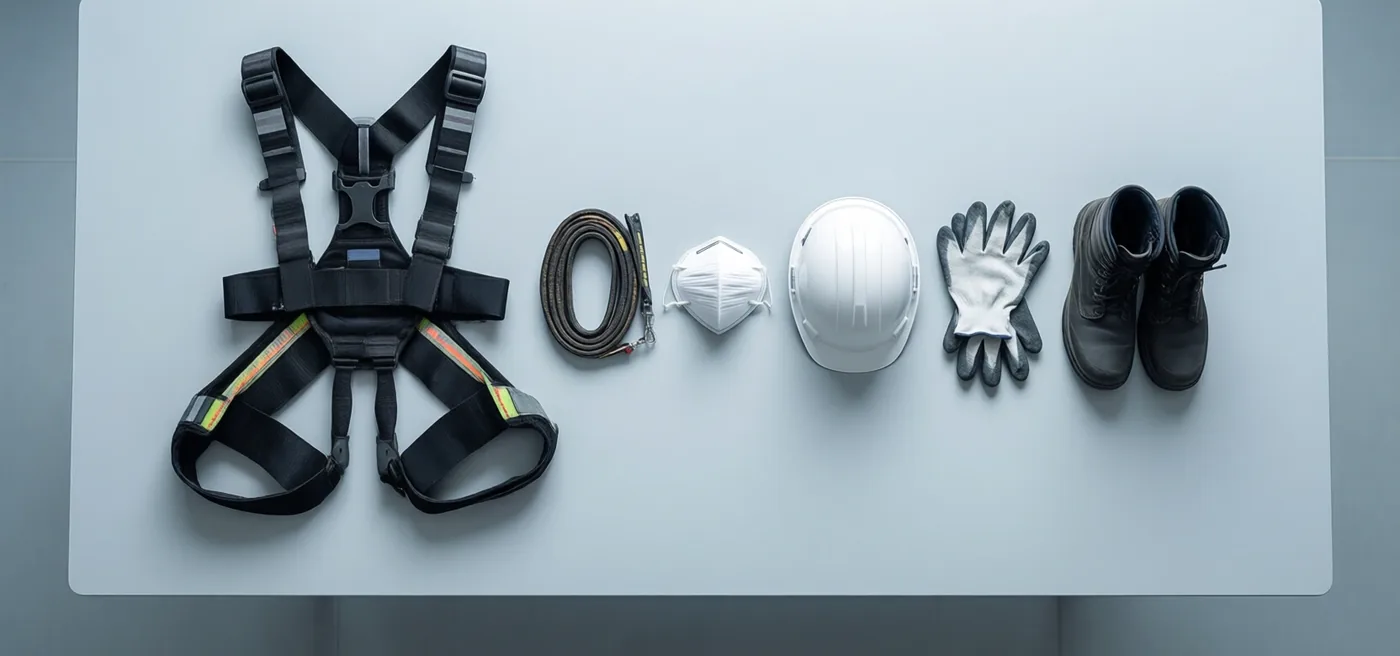
Fall protection
Category IIIModule B + C2/D
Industrial fall-arrest systems and mountaineering PPE — full-body harnesses, lanyards, energy absorbers, connectors, anchor devices and rope-adjustment systems.
Respiratory protection
Category IIIModule B + C2/D
Filtering half masks against particles (EN 149) and filtering half masks without inhalation valves (EN 1827).
Head protection
Category IIModule B (EU type-examination)
Industrial safety helmets, bump caps and mountaineering helmets. As Category II PPE these need EU type-examination — production control (Module C) stays with the manufacturer.
Safety footwear & gloves (Cat III)
Category IIIModule C2/D
Production surveillance for Category III safety footwear and protective gloves. Our local auditors keep travel-related costs low.
What you provide: documentation and samples
EU type-examination rests on examining the technical documentation and testing representative samples — so we ask for both. Under Annex III the documentation includes at least:
- ✓A complete description of the PPE and its intended use
- ✓An assessment of the risks the PPE protects against
- ✓The list of applicable essential health and safety requirements
- ✓Design and manufacturing drawings and schemes
- ✓The harmonised standards applied (or other technical specifications)
- ✓Results of design calculations, inspections and examinations
- ✓Test reports establishing conformity and the protection class
- ✓A copy of the manufacturer’s instructions and information
Alongside the documentation we also ask for representative samples (specimens) of the PPE — partly for laboratory testing, partly for the assessment. The notified body may request further specimens to carry out the test programme (Annex V).
Source: Regulation (EU) 2016/425, Annex III. GÉPTESZT helps you compile and complete the file.
Practical advantages for manufacturers
GÉPTESZT applies the Regulation the way the notified bodies have agreed to interpret it (the Recommendations for Use) — which turns into concrete savings in cost, time and risk for you.
Remote production checks (Module C2)
Where it is risk-appropriate, we can carry out Module C2 product sampling remotely by video. The Regulation obliges notified bodies to avoid unnecessary burdens on manufacturers (Article 32(2)) — so you save the travel and on-site cost of surveillance and it happens faster.
We build on your existing test data
Whether existing test data can replace a repeat test is a conformity-assessment decision — so it rests with the notified body, not the test bench. We can accept accredited test reports, and, where a test falls outside an accredited scope, data we verify against the applicable ISO/IEC 17025 requirements. Any testing we run ourselves is done in our in-house ISO/IEC 17025 laboratory. Whether the data is a subcontracted lab’s or ours, the notified body reviews it and takes full responsibility for what it accepts (Article 26). Fewer repeat tests, a faster route to your certificate.
We assess foreseeable use — not just the claimed use
If a product’s design could be read as protecting against a use it does not actually cover, a warning in the manual is not enough under the Regulation. We flag it during type-examination and guide the design or marking fix — so your PPE does not run into a market-surveillance problem after launch.
Why GÉPTESZT?
An EU notified body since 2009, with our own testing laboratory and auditors close to your production — so certification is thorough, fast and cost-efficient.

GÉPTESZT is an active member of the PPE Notified-Bodies coordination — the Horizontal Committee and the relevant Vertical Groups — the forum that develops the Recommendations for Use (RFUs) that harmonise how the PPE Regulation is applied across the EU.
One laboratory, two capacities. Our testing laboratory is physically a single unit: within our notified-body scope we run the tests required for EU type-examination, and under ISO/IEC 17025 accreditation we test to other standards (for example ANSI) and non-PPE items — so testing for the EU and for international markets can be done in one place.
Notified Body since
verifiable in NANDO
manufacturers supported
countries
- ✓In-house ISO/IEC 17025 testing laboratory — in both notified and accredited capacities.
- ✓Local auditors worldwide — lower travel and audit costs.
- ✓Independent, impartial conformity assessment.
- ✓Notification verifiable in the EU NANDO database.
Frequently asked questions
Do I need a notified body for my PPE?▾
Does it matter whether I am established inside or outside the EU?▾
I sell PPE under my own brand but it is made by another factory (OBM / private label) — who is the manufacturer?▾
What is the difference between Module C2 and Module D?▾
How long is an EU type-examination certificate valid?▾
My product has a certificate under the old PPE Directive 89/686/EEC — is it still valid?▾
What does the number after the CE mark mean?▾
What do I need to submit for certification?▾
Can you also test to non-EU standards, for example ANSI?▾
My product combines a Category II item with a Category III accessory (e.g. a helmet with mounted earmuffs) — does the whole assembly need a notified body?▾
My PPE carries more than one company name or trademark — how must they be labelled?▾
Can one EU type-examination certificate cover several products?▾
Can I use one "universal" instruction manual for several PPE products?▾
Can I put the ATEX marking on my PPE?▾
Legal background
Links point to the current official text; the Hungarian decrees are available in Hungarian only.
- (EU) 2016/425 — PPE Regulation
The EU Regulation on placing PPE on the market. Article 19 sets the conformity assessment procedures; Annex I the risk categories; Annexes IV–VIII the modules.
- European Commission — PPE Regulation (EU) 2016/425 Guidelines
The European Commission’s official guidance manual interpreting the PPE Regulation — the source of the category and module explanations quoted on this page.
Ready to CE-mark your PPE?
Tell us your product and its risk category — we’ll map the exact route (Module B, C2/D) and give you a clear quote.