JACOP 2025: one in five sampled safety helmets failed the shock absorption test
Oct 25, 2026 · 9 min read
An industrial safety helmet has one real job: to absorb the energy of a falling object before it reaches the head. In 2025 EU market surveillance tested 65 helmets to see whether the ones on the shelf and in the web shop can do that – eight in ten could, one in five could not.
Product-specific activity (PSA) 9 of the JACOP 2025 joint market surveillance programme assessed whether industrial safety helmets for professional use placed on the EU market comply with Regulation (EU) 2016/425 on personal protective equipment (PPE) and EN 397:2012+A1:2012. The final report was published by the Publications Office of the EU; the European Commission reported on it on 15 September 2026.
The two results mirror each other: in the laboratory 46 helmets passed and 19 failed; counting markings and documentation as well, it is the other way round – 46 helmets failed at least one requirement and 19 were in order in every respect.
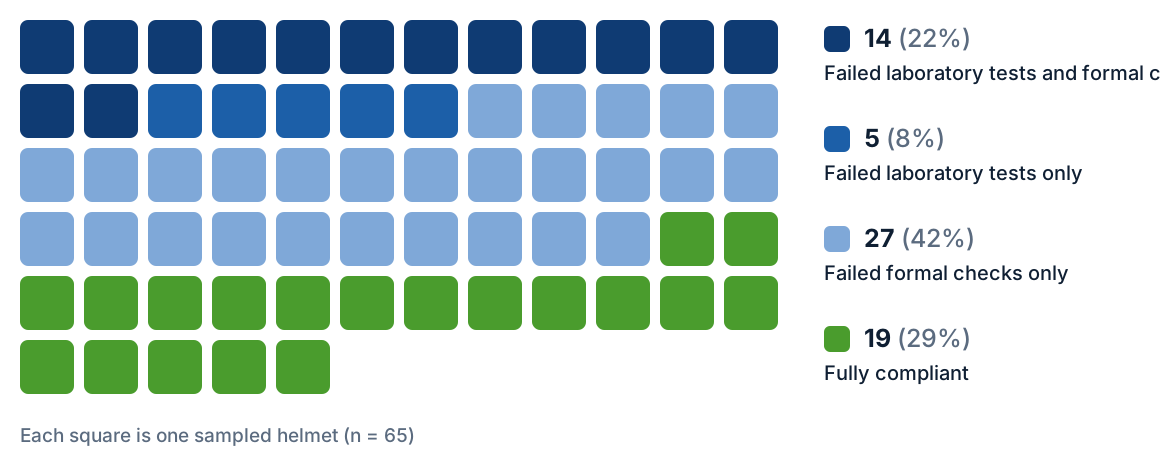
The report describes two distinct patterns: technical failures are concentrated in shock absorption, while marking and documentation deficiencies are at least as widespread – 41 helmets against 19 – and often occur alongside the technical ones. Derived from the counts, 14 of the 19 helmets that failed in the laboratory also had marking or documentation deficiencies, while 5 passed the documentary check; 27 helmets had marking or documentation deficiencies only, and 19 helmets passed everything.
What was tested?
PSA 9 covered industrial safety helmets for professional use; firefighters’ helmets were excluded and no testing against electrical hazards was carried out. Under Regulation (EU) 2016/425 an industrial safety helmet falls into risk Category II: it requires EU type-examination (Module B) by a notified body, after which conformity of serial production to the type is the manufacturer’s responsibility, through its own internal production control (Module C).
An ISO/IEC 17025 accredited laboratory tested the samples against the standard’s mandatory requirements – and, where a helmet claimed it, the optional very low temperature requirement. The impact and penetration tests are carried out after conditioning: the helmet is first kept in heat, in cold, in water or under UV light, because the materials of the shell and the harness may change. The authorities also checked markings and documentation with a commonly agreed checklist: the presence and legibility of the CE marking and the economic operator’s details, the instructions for use and the EU Declaration of Conformity. Samples were collected in February and March 2026; the participating authorities are listed at the end of the article.
| Clause | Requirement | What it means in practice |
|---|---|---|
| 5.1.1 | Shock absorption | A 5 kg striker falls 1 metre onto the helmet; the force transmitted to the headform may not exceed 5 kN – after conditioning at high, low or very low temperature, water immersion and UV ageing |
| 5.1.2 | Resistance to penetration | A 3 kg conical striker falls 1 metre; it must not touch the headform – after the same conditioning procedures |
| 5.1.3 | Flame resistance | After the flame is removed, the shell may burn for no more than 5 seconds – all 65 helmets |
| 5.1.4 | Chinstrap anchorage | The anchorage must release at a force between 150 and 250 N: strong enough to keep the helmet on, yet releasing before the strap can injure – only the 18 helmets fitted with a chinstrap |
| 5.1.5 | Label durability | The label remains legible after the test – all 65 helmets |
Shock absorption: where most of it was decided
In the shock absorption test 13 helmets (20%) failed and 52 (80%) passed. By conditioning: 8 of the 65 helmets failed after high temperature conditioning, 5 of 27 after low temperature, 2 of 38 after very low temperature, 1 after water immersion and 3 of 65 after UV ageing. A helmet could fail after more than one conditioning: the 19 failures concern 13 helmets. Low temperature conditioning was applied to 27 helmets and very low temperature conditioning to 38 – in proportion, low temperature was the hardest test.
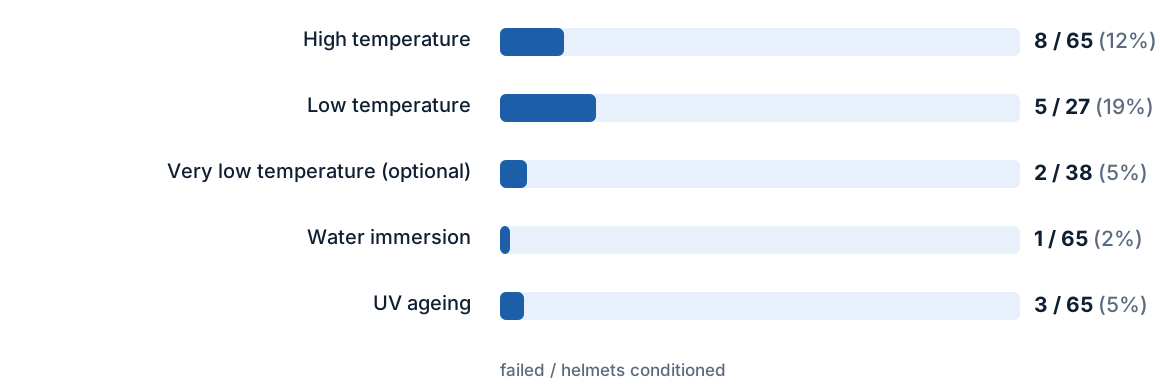
Shock absorption is the basic function of an industrial helmet: the helmet has to absorb the energy of a falling object so that the force transmitted to the head stays below the standard’s 5 kN limit. Conditioning checks whether the materials of the shell and the harness behave the same way on a summer roof and outdoors in winter. The authorities assessed the shock absorption failures as a hazard linked to the kinetic energy of flying and falling objects.
The other requirements: few failures, but not zero
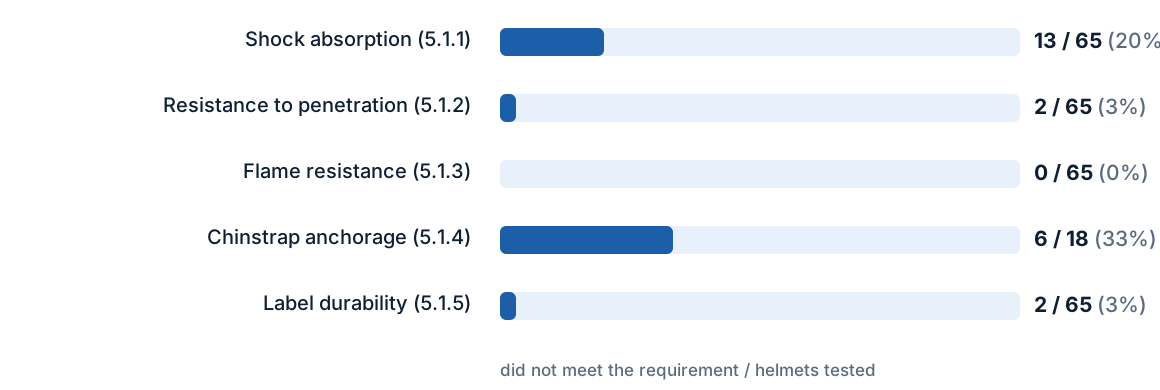
Two helmets (3%) failed the resistance to penetration test and two (3%) the label durability test; all 65 met the flame resistance requirement. The chinstrap anchorage requirement applied to 18 helmets, and on 6 of them (33%) the anchorage did not release within the force band set by the standard – the highest share of any test, even if the numbers are small. In total 19 helmets (29%) failed at least one laboratory test.
Marking and documentation: 41 helmets
The checks of markings and documentation found deficiencies in 41 helmets (63%). The most common faults: the manufacturer’s or importer’s identification – in particular the name and postal address – was missing or incomplete; the helmet label required by clause 7.2.1 was missing or not in the language of the country of sale; the instructions for use were missing, incomplete or not provided in the national language; and the EU Declaration of Conformity was missing, could not be traced to the product, or referred incorrectly to the standard or the notified body. This is not mere paperwork: the risk assessment treated inadequate warning texts and symbols as hazards too. (Label durability – the laboratory test that 2 helmets failed – is a separate matter: there, the question is whether the print stays legible.)
Risk assessment and enforcement measures
The authorities assessed the risk of the 46 non-compliant helmets on the basis of the laboratory results, the marking and documentation deficiencies and the intended protective function of a helmet. The top of the scale is serious risk; no risk was found in 7 cases, the level was not specified in 7, and for several cases the assessment of the safety implications was still being finalised when the report was written.
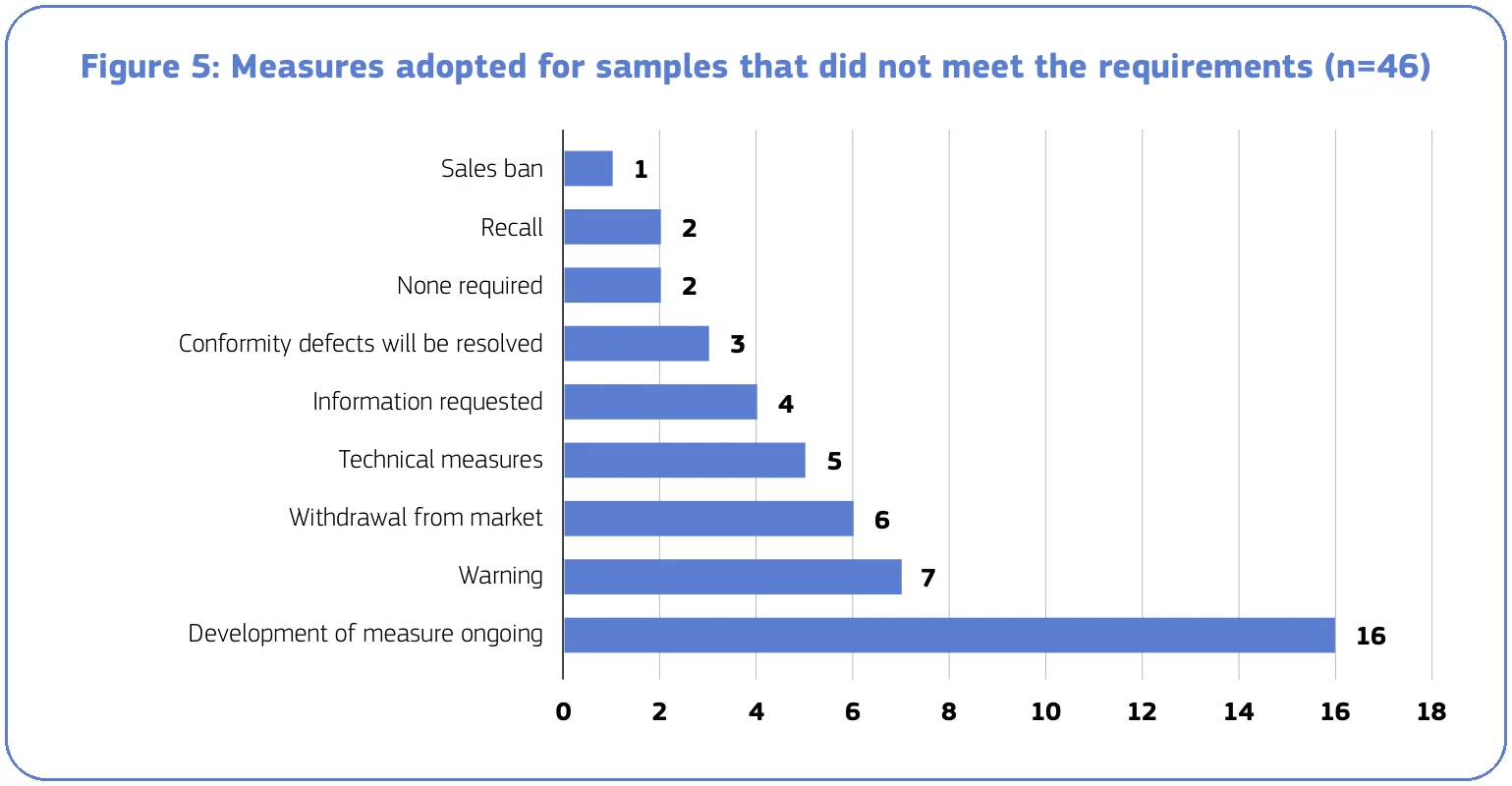
For 16 of the 46 helmets the appropriate measure was still being developed at the reporting cut-off of 31 July 2026. The most serious steps: 6 helmets were withdrawn from the market, 2 were recalled – including units already sold – and 1 received a sales ban; in six cases a secondary measure followed. 39 products were registered in ICSMS – the EU’s secure platform where the authorities share test results with each other – and in the public Safety Gate alert system one helmet had been notified at the report’s cut-off, seven more were still to be notified, and according to the Commission’s September news item eight helmets have since been listed.
What may change?
The report recommends that the Commission strengthen EU-wide cooperation and information exchange, support more market surveillance of PPE for professional users, and consider requiring the original manufacturer to be named in the documentation where a product is marketed under a private label. To the market surveillance authorities it recommends sampling helmets on the market more often and examining both their documentation and their performance, cooperating with customs, and taking part in joint actions and in standardisation working groups. To standardisation organisations: explain the changes introduced by revisions of the standard (for example the missing requirement for the maximum force applied to the retention system), clarify the number of samples needed for testing and the interpretation of measurement uncertainty, and consider requirements for the effectiveness of the retention system of Type 1 helmets.
What does this mean for manufacturers and distributors?
One message of the report concerns own-brand sales: whoever has PPE designed, manufactured and marketed under their own name or trademark is the manufacturer and carries all of the manufacturer’s obligations – from the technical documentation to the EU Declaration of Conformity. A gap can open between three steps:
- 1 EU type-examination (Module B)The notified body tests and certifies the prototype: the certificate covers the type.
- 2 Serial production (Module C)For Category II PPE – industrial safety helmets among it – the manufacturer is responsible for the match between the series and the type, through its own internal production control; no notified body is involved at this stage.
- 3 The product on the marketThe market surveillance authority measures a helmet taken from the shelf or the web shop against the standard’s requirements. PSA 9 found faults at this level in 71% of the helmets; whether the faulty units deviated from their certified type is not something the report examined.
The report does not say what certificate stood behind the faulty helmets; it does record that some declarations of conformity could not be traced to the product or referred incorrectly to the standard or the notified body. Under Annex IX of Regulation (EU) 2016/425 the EU Declaration of Conformity must identify the product, the manufacturer, the harmonised standard applied and the notified body that carried out the EU type-examination, together with the certificate number – from these, a buyer can check that the declaration refers to the helmet in hand.
- Measures were directed at the manufacturer in 18 cases, at the distributor in 16 and at the importer into the EEA (the European Economic Area) in 3: responsibility reaches every link in the chain.
- A helmet placed on the market must meet the requirements of Regulations (EU) 2016/425 and (EU) 2019/1020 and of the harmonised standard: EU Declaration of Conformity and technical documentation, instructions for use in the national language, marking and labelling, technical specifications.
- Placing unsafe or non-compliant PPE on the market may harm workers and can lead to enforcement actions, recalls and liability for damages.
As a notified body, GÉPTESZT carries out the EU type-examination of industrial safety helmets to EN 397; the certificate covers the type, and the conformity of serial production is the manufacturer’s task.
What can employers and wearers do?
Five steps before you issue or put on a safety helmet – based on the report’s recommendations to employers and wearers:
- 1 From risk to helmetChoose a professional helmet designed for the specific risks of the workplace – it can reduce the severity of injuries. Not every helmet on the market provides the level of protection a workplace needs.
- 2 A five-point goods-receipt checkThe CE marking on the helmet; the name and postal address of the manufacturer and the importer; the label required by clause 7.2.1 in the language of the country of sale (see the box above); instructions for use in your language; an EU Declaration of Conformity traceable to the product – supplied with it or at the internet address given in the instructions.
- 3 Fit and accessoriesAdjust the fit as the instructions describe, and use only the accessories and spare parts the manufacturer allows; the rules for storage and maintenance are there too.
- 4 Replace after a severe impactA helmet that has taken a severe impact must be replaced even if no damage is visible – its protective performance is reduced. A helmet without a CE marking may not provide the expected protection.
- 5 ReportIf you detect or suspect an unsafe or non-compliant helmet, tell the employer and the market surveillance authority – in Hungary, for PPE used at work, the occupational safety authority, i.e. the government offices; as a private individual you can also report it through the Consumer Safety Gateway.
The participating authorities
| Country | Market surveillance authority | Samples |
|---|---|---|
| Belgium | Federal Public Service Economy, SMEs, Self-Employed and Energy | 9 |
| Cyprus | Department of Labour Inspection | 5 |
| Germany | District Government of Arnsberg | 10 |
| Germany | Saxony State Directorate | 5 |
| Germany | Government of Upper Bavaria | 5 |
| Greece | Hellenic Ministry of Development – Safety and Compliance of Industrial Products Directorate | 6 |
| Ireland | Health and Safety Authority | 5 |
| Netherlands | Netherlands Labour Authority | 5 |
| Spain | Directorate General for Economy and Industry – Madrid Region | 5 |
| Sweden | Swedish Work Environment Authority | 10 |
Sources
- JACOP 2025 – PPE Professional Helmets – Final reportPublications Office of the European Union, 2026. ET-01-26-102-EN-N, doi:10.2873/4823559. The source of every figure in this article.
- JACOP 2025 – PPE – Munkavédelmi sisakok – Zárójelentés (Hungarian edition)ET-01-26-102-HU-N, doi:10.2873/4085868.
- EU tests show most professional safety helmets meet key requirements – European Commission news (15 September 2026)Source of the eight Safety Gate listings and the seven warnings.
- How well do industrial safety helmets protect your head? – the PSA 9 infographic
- Market surveillance – joint actions (JACOP) – European Commission, DG GROW
- Harmonised standards – personal protective equipment (European Commission)Implementing Decision (EU) 2026/1279 and the summary list: EN 397:2025 from 16 June 2026, presumption of conformity of EN 397:2012+A1:2012 until 16 December 2027.
- Safety Gate – the EU rapid alert system for dangerous non-food products
- Regulation (EU) 2016/425 on personal protective equipment
Questions about PPE certification?
Our team is glad to help with PPE laboratory testing, EU type-examination (Module B) and Module C2/D production surveillance.
Contact us