JACOP 2025: 82% of sampled safety footwear failed at least one check
Oct 25, 2026 · 9 min read
An EU type-examination certificate for a safety shoe covers the type. Whether the pair on the shelf or in the web shop performs the same was checked by EU market surveillance on 83 models in 2025 – and most of them had something wrong.
Product-specific activity (PSA) 11 of the JACOP 2025 joint market surveillance programme assessed whether safety footwear for professional use placed on the EU market complies with Regulation (EU) 2016/425 on personal protective equipment (PPE) and the harmonised standard EN ISO 20345. The final report was published by the Publications Office of the EU; the European Commission reported on it on 13 October 2026. Of the 83 models, 68 showed at least one non-compliance – in the laboratory performance tests, in the formal checks of documentation and markings, or in both.
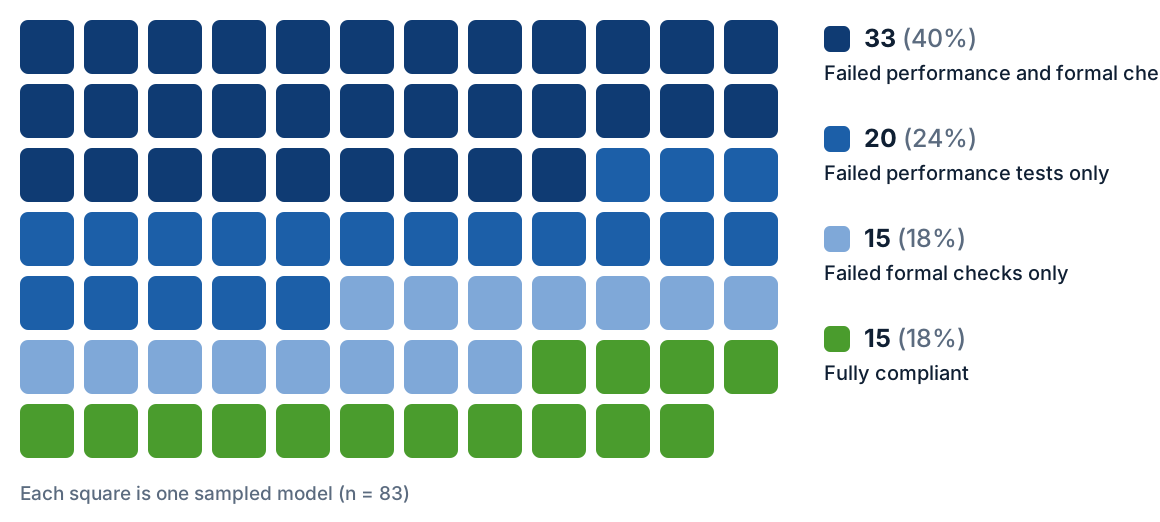
The two levels of checking do not replace each other: 33 models failed both, 20 models (nearly a quarter of the sample) passed the formal check but failed in the laboratory, and another 15 the other way round – the product performed, the documentation and marking did not. Only 15 models passed everything. The authorities concluded that checking documentation, markings and instructions alone is not sufficient to show that footwear on the market is safe.
What was tested, and how?
PSA 11 covered safety shoes for workplace use fitted with a protective toe cap, from the basic SB category to S1–S5. Under Regulation (EU) 2016/425 this footwear falls into risk Category II: it requires EU type-examination (Module B) by a notified body, after which conformity of serial production to the type is the manufacturer’s responsibility, through its own internal production control (Module C).
| Protection category | What it includes |
|---|---|
| SB | The basics: a toe cap resisting a 200 J impact and 15 kN compression – for dry indoor work |
| S1 | SB + closed heel, antistatic properties, energy-absorbing heel |
| S2 | S1 + upper resistant to water penetration and absorption |
| S3 | S2 + penetration-resistant sole and cleated outsole – the large majority of the sample (62 models) |
| S4 / S5 | The equivalents of S1 and S3 for all-rubber or all-polymer boots |
The authorities collected 83 samples, combining targeted, risk-based selection with non-targeted sampling according to their national strategies. Most samples were S3 footwear (62 models); the rest fell into the SB, S1 and S5 categories; products of EU- and non-EU-based economic operators were both represented. The three German authorities contributed the most samples; no Hungarian authority took part in this activity.
An accredited laboratory tested the samples to EN ISO 20345:2022 (models made available before 2022 to the 2011 edition). The testing plan focused on selected mandatory requirements of each model’s declared protection category – 313 performance tests in total. In addition, the authorities carried out the formal checks with a commonly agreed checklist: the presence and legibility of the protection category, the CE marking, the instructions for use, warnings and the economic operator’s details.
What do the four tests measure?
| Test | What situation it models | Requirement under EN ISO 20345 |
|---|---|---|
| Impact resistance | An object falling on the foot | The toe cap still leaves clearance above the toes after a 200 J impact |
| Compression resistance | Trapping, a load rolling over the foot | The toe cap does not flatten onto the toes under a 15 kN force |
| Perforation resistance | A nail or metal swarf under the sole | The test nail does not pass through the insert at 1,100 N |
| Antistatic properties | Static charge – sparks in a flammable environment | Electrical resistance stays between 100 kΩ and 1,000 MΩ, so the charge is dissipated; no protection against electric shock |
| Cut resistance | A sharp object against the upper | An optional (CR) requirement – a single model in the sample claimed it |
Performance tests: antistatic properties are the weakest point
Of the 313 tests, most failures concerned antistatic properties: 28 of the 68 models tested for them (41%) did not meet the requirement. Impact resistance came next (20 of 83 models, 24%), followed by perforation resistance (14 of 78, 18%) and compression resistance (5 of 83, 6%). The only model tested for cut resistance passed.
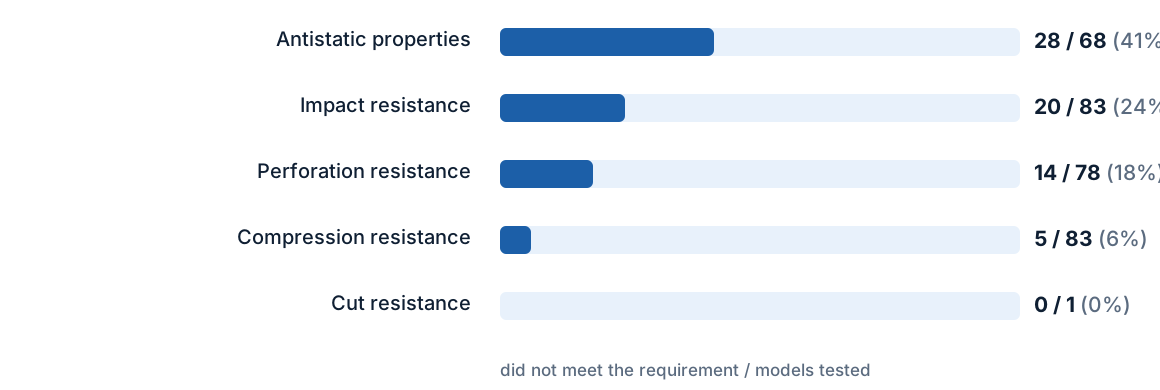
Antistatic behaviour is no detail: it is required in every category from S1 upwards, and by dissipating static charge it reduces the risk of sparks in a flammable environment – it does not, however, protect against electric shock. Impact and perforation resistance are the very essence of safety footwear – protection against a falling object and against an object piercing the sole.
Documentation and marking: 48 models
Formal checks failed for 48 models (58%). The deficiencies named in the report: a missing or incorrectly affixed CE marking, instructions for use not available in the required national language(s), and no indication of the protection category. The report also stresses that products placed on the EU market must identify a responsible economic operator with a name and address in the EU/EEA.
Risk assessment and enforcement measures
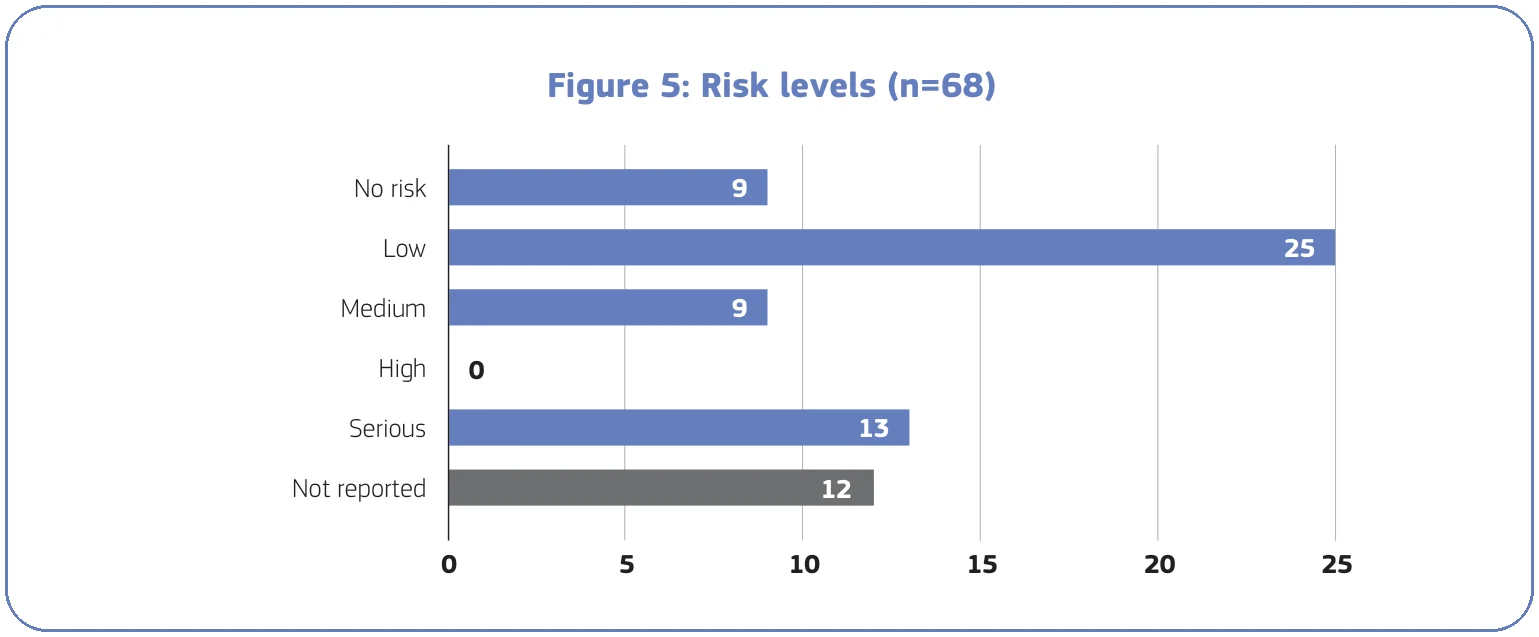
The authorities assessed the risk of the 68 non-compliant samples on the basis of the type of non-compliance and the probability and severity of the potential harm. The top of the scale is serious risk: 13 models were placed there; 9 were rated medium and 25 low, no risk was found in 9 cases and no result was reported in 12; no model was rated a high risk.
Some online marketplaces were instructed to remove the products concerned. According to the Commission’s news item of 13 October 2026, one economic operator was fined EUR 7 000 for shoes that lacked the protective features they claimed. The authorities registered the tested products in ICSMS – the market surveillance authorities’ shared European register – and issued Safety Gate alerts in the serious cases. The measures reflect what was reported by the cut-off date of 30 July 2026; follow-up continues beyond it.
What may change?
The report recommends that the Commission oblige online platforms to make the EU Declaration of Conformity, the instructions for use and the responsible economic operator’s details available; consider requiring the name and address of the original manufacturer, in addition to the legal manufacturer, in the EU Declaration of Conformity or the technical documentation; and clarify – for example in the notified bodies’ horizontal recommendations for use (RfUs) – how measurement uncertainty is to be taken into account in market surveillance testing.
To the market surveillance authorities it recommends checking safety footwear more often and more widely, with laboratory testing alongside documentary checks, and closer cooperation with customs. To standardisers it proposes methods that better reflect real use: a dynamic perforation test, an antistatic test that takes ageing, grease and moisture into account as an additional, optional requirement, and clear rules on measurement uncertainty in the harmonised standards.
What does this mean for manufacturers and importers?
The report’s main message to manufacturers is that discrepancies were observed between the product assessed at type-examination and the product placed on the market. A gap can open between three steps:
- 1 EU type-examination (Module B)The notified body tests and certifies the prototype: the certificate covers the type.
- 2 Serial production (Module C)For Category II PPE – safety footwear among it – the manufacturer is responsible for the match between the series and the type, through its own internal production control; no notified body is involved at this stage.
- 3 The product on the marketThe market surveillance authority tests a sample taken from the shelf or the web shop. PSA 11 found the discrepancies between the first and the third step.
As a notified body we check the same match for Category III PPE through supervised product checks under Module C2 or quality-assurance surveillance under Module D; in Category II it is the manufacturer’s own task.
- Know and fully meet your obligations under Regulation (EU) 2016/425; placing unsafe or non-compliant footwear on the market may lead to fines, recalls and liability for damages.
- Markings, instructions for use and safety information must be complete, accurate and available in the required national language(s).
- The product must identify the responsible economic operator with up-to-date contact details in the EU/EEA.
- Where necessary, verify with the issuing notified body that the conformity documentation – for example the EU type-examination certificate – is valid.
Importers and distributors should require the same along the supply chain: besides a copy of the certificate, check that the markings of the delivered product match the type named on the certificate. The validity of a certificate is confirmed by the notified body that issued it; manufacturers outside the EU also need a responsible economic operator established in the EU – we cover that in a separate article.
What can employers and wearers do?
Six steps before you issue or put on safety footwear – based on the report’s recommendations to end users:
- 1 From risk to categoryChoose the protection category and the additional properties on the basis of the workplace risk assessment and the applicable occupational safety rules.
- 2 Source and paperworkBuy from a reputable source; in a shop or online, check the CE marking, the EU Declaration of Conformity and the instructions for use in your language, and ask the seller whether the product provides the level of protection you need.
- 3 The tongue of the shoeThe label sewn into the tongue must show the standard, the protection category, the manufacturer’s details, the size and – where given – the production date.
- 4 Safety GateBefore buying, search the Safety Gate alerts for the product or the brand: has it been identified as dangerous or recalled?
- 5 ConditionCheck the condition and – where given – the expiry date of the footwear before use; a damaged toe cap or sole no longer protects.
- 6 ReportIf you detect or suspect an unsafe or non-compliant product, report it to the market surveillance authority – in Hungary, for PPE used at work, the occupational safety authority, i.e. the government offices – or through the Consumer Safety Gateway.
The participating authorities
| Country | Market surveillance authority | Samples |
|---|---|---|
| Cyprus | Department of Labour Inspection, Ministry of Labour and Social Insurance | 5 |
| Germany | State Office for Health and Social Affairs Mecklenburg-Western Pomerania, Department 5 – Occupational Safety | 15 |
| Germany | District Government of Arnsberg, Environment, Health, Occupational Safety | 10 |
| Germany | Regional Council Tübingen | 5 |
| Luxembourg | Luxembourg Institute of Standardisation, Accreditation, Safety and Quality of Products and Services (ILNAS) – Market Surveillance department | 9 |
| Netherlands | Netherlands Labour Authority | 12 |
| Norway | Norwegian Labour Inspection Authority | 5 |
| Portugal | Economic and Food Safety Authority | 2 |
| Spain | Economy and Industry Directorate of the Community of Madrid | 5 |
| Sweden | Swedish Work Environment Authority, Product Regulations and Market Surveillance Unit | 10 |
Sources
- JACOP 2025 – PPE Professional Footwear – Final reportPublications Office of the European Union, 2026. ET-01-26-103-EN-N, doi:10.2873/2283313. The source of every figure in this article.
- JACOP 2025 – PPE – Munkavédelmi lábbelik – Zárójelentés (Hungarian edition)ET-01-26-103-HU-N, doi:10.2873/7296803.
- EU tests reveal compliance issues in safety footwear – European Commission news (13 October 2026)Source of the EUR 7 000 fine example.
- Market surveillance – joint actions (JACOP) – European Commission, DG GROWAll JACOP 2025 product cards with news, infographics and final reports.
- EN ISO 20345 classes: what SB, S1, S1P, S2 and S3 mean – BIMEO knowledge centreThe guide of our partner notified body (NB 1524) to the protection categories.
- Safety Gate – the EU rapid alert system for dangerous non-food products
- Regulation (EU) 2016/425 on personal protective equipment
Questions about PPE certification?
Our team is glad to help with PPE laboratory testing, EU type-examination (Module B) and Module C2/D production surveillance.
Contact us