JACOP 2025 and Safety Gate: how the EU polices product safety
Oct 25, 2026 · 9 min read
The CE marking is the manufacturer’s declaration that a product meets the EU requirements. Whether that declaration is also true of the product on the shelf is checked by the market surveillance authorities of the member states. Every year the European Commission organises a joint testing programme for them: JACOP, the Joint Actions on Compliance of Products.
The 2025 programme brings together 11 product-specific activities (PSAs) in 9 sectors, from fertilisers and lifts to safety helmets and safety footwear. This article explains how the programme works, how the results reach the public – and how anyone can raise the alarm about an unsafe product.
What is JACOP?
The JACOP initiative aims to have the market surveillance authorities (MSAs) of the EU and EFTA countries test products jointly, assess risks jointly and harmonise their working methods. The programme is supervised by the Commission’s Directorate-General for Internal Market, Industry, Entrepreneurship and SMEs (DG GROW); the European Innovation Council and SMEs Executive Agency (EISMEA) is the contracting authority; and implementation is carried out by contractors – in the 2025 programme EY, ESN and MCI – supported by technical experts.
The point of a joint action is that the testing is funded by the EU and the participating authorities gain testing capacity on top of their national resources: samples are collected under a commonly agreed testing plan, tested by a jointly selected accredited laboratory, and the results are evaluated together. The authorities remain the decision-makers: they monitor their national markets, collect the samples and take the measures.
The 11 product-specific activities of JACOP 2025
DG GROW selected the 11 product categories in a priority-setting exercise in consultation with the Administrative Cooperation Groups (AdCos). The products are selected and collected by the market surveillance authorities involved and examined under the agreed testing plan. Personal protective equipment (PPE) features in three activities.
Timeline: two cycles, four phases
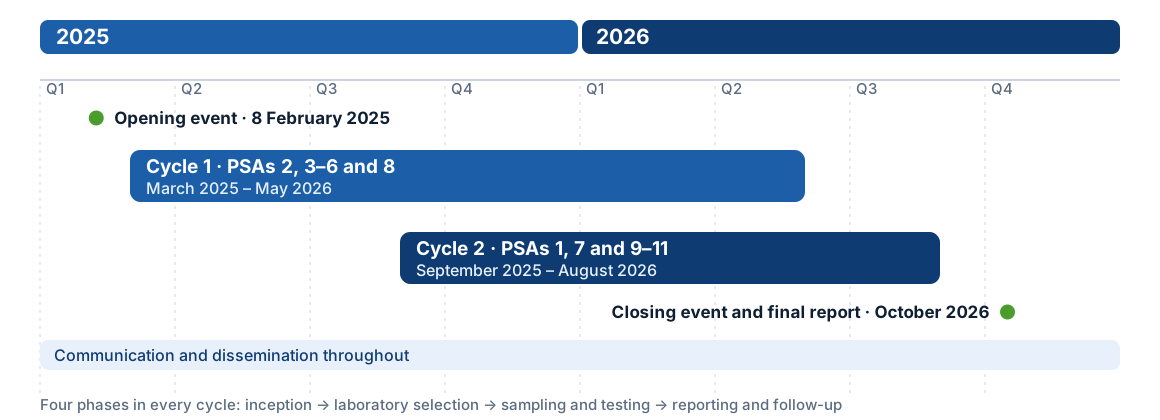
The programme opened on 8 February 2025. The 11 activities run in two cycles: the first (PSAs 2, 3–6 and 8) from March 2025 to May 2026, the second (PSAs 1, 7 and 9–11) from September 2025 to August 2026. The closing event and the final report covering the whole programme are due in October 2026. Every activity goes through the same four phases:
- 1 InceptionDesk research, drafting the testing plan and mapping laboratories. Milestone: the kick-off meeting, where the authorities agree on the product scope and the testing criteria.
- 2 Laboratory selectionA tendering process and contracting. Milestone: the intermediate meeting, where the authorities review the laboratories’ proposals and select one.
- 3 Sampling and testingThe authorities collect samples from their national markets, check the documentation and send the samples to the laboratory. Milestone: the laboratory meeting, where the results are presented and the risk assessment discussed.
- 4 Reporting and follow-upAgreed risk assessment, measures against non-compliant products and the final report. Milestone: the final meeting, where the conclusions and recommendations are presented.
What happens to non-compliant products?
The authorities assess the risk of every sample that fails the legal requirements, on the basis of the type of non-compliance and the probability and severity of the potential harm. The common SAGA tool (Surveillance Assistance and Guidance Analytics) supports a harmonised approach.
Measures follow European and national law: sales bans, withdrawal from the market, recalls, warnings or fines for economic operators, and instructions to online marketplaces to remove the listings concerned. The tested products are registered in ICSMS – the authorities’ shared European information and communication system – and products presenting a serious risk are notified through Safety Gate.
Safety Gate: the public alert system
Safety Gate is the EU rapid alert system for dangerous non-food products. When a national authority identifies a product presenting a serious risk and acts against it, the alert – with the product’s photo, brand, type, a description of the risk and the measure taken – also appears on the system’s public portal. The portal is free for everyone and available in the official EU languages; alerts can be searched by product, brand, category or country, and weekly overviews are published.
In 2025 the system recorded 4,671 alerts and 5,794 follow-up actions – according to the Commission’s Safety Gate report for 2025, the highest number since the system was launched in 2003. More than a third of the alerts concerned cosmetics, and chemical risks were the most frequent. PPE appears on the list regularly too.
Three gateways: who reports what, and where
Safety Gate has three elements: the alert system between authorities, the public portal and the reporting gateways. There are two of the latter, and they must not be confused: one is for consumers, the other for economic operators.
How to report a dangerous product
- 1 Check whether an alert already existsSearch the Safety Gate portal for the product or the brand. If there is already an alert or a recall, follow the steps it describes – for example stop using the product and return it to the seller.
- 2 Gather the detailsProduct name, brand, type or model number, the name of the manufacturer or importer, where and when it was bought, photos of the product and its markings, and a description of the problem or the accident.
- 3 Submit it through the Consumer Safety GatewayThe Consumer Safety Gateway form can be completed in any official EU language. The report is received by the competent national market surveillance authority, which investigates the case and decides on measures.
- 4 Or contact the national authority directlyIn Hungary, market surveillance of PPE intended for use at work is carried out by the occupational safety authority – at first instance the government offices of Budapest and the counties – and of consumer products by the consumer protection authority. At a workplace, the first point of contact is always the employer.
- 5 As a business, use the Safety Business GatewayIf you learn as a manufacturer, importer or distributor that one of your products is dangerous, informing the authorities is mandatory; the EU-level channel for this is the Safety Business Gateway.
What can manufacturers learn from the joint actions?
The PPE results of the 2025 programme – including the safety helmet and safety footwear activities, which we cover in separate articles – show a recurring pattern: besides laboratory performance, documentation, marking and the instructions for use are the most frequent sources of failure. These requirements are not formalities: without the protection category on the product, instructions in the required national language and the responsible economic operator’s contact details, the user cannot judge what to expect from the product.
As a notified body, GÉPTESZT assesses the type in EU type-examination (Module B); for Category III PPE, production surveillance under Module C2 or D also checks that serial production matches the type. Market surveillance is an independent third level of control: the authority examines the product on the market. It is the manufacturer’s responsibility that all three levels see the same product.
- Serial production must conform to the certified type – for Category II PPE this rests solely on the manufacturer’s internal production control.
- Instructions for use and markings must be complete, accurate and available in the language of the member state where the product is sold.
- A product placed on the EU market must carry the name and EU/EEA address of the responsible economic operator under Article 4 of Regulation (EU) 2019/1020.
- Follow the Safety Gate alerts in your own product category: enforcement practice shows there first.
Sources
- Market surveillance – joint actions (JACOP) – European Commission, DG GROWThe JACOP 2025 product cards with news, infographics and final reports.
- JACOP 2025 – PPE Professional Footwear – Final reportPublications Office of the European Union, 2026. Part 2 (the programme) is identical in every PSA final report. ET-01-26-103-EN-N, doi:10.2873/2283313.
- Safety Gate – the EU rapid alert system for dangerous non-food products
- Consumer Safety Gateway – report a dangerous product
- Safety Business Gateway – notifications by economic operators
- Safety Gate 2025 – annual report (European Commission)Source of the 2025 alert statistics.
- Regulation (EU) 2019/1020 on market surveillance and compliance of products
- Regulation (EU) 2023/988 on general product safetyThe legal basis of Safety Gate and of consumer reporting.
- ICSMS – the information and communication system of the market surveillance authorities
Questions about PPE certification?
Our team is glad to help with PPE laboratory testing, EU type-examination (Module B) and Module C2/D production surveillance.
Contact us